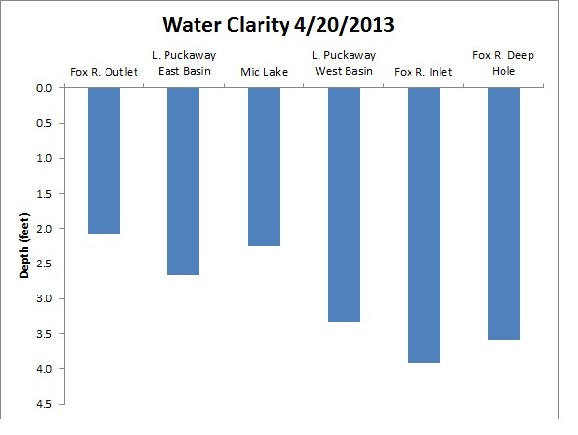
Today's average in-lake water clarity was 4.2 feet, and was courtesy of a massive zooplankton bloom. It is massive in that zooplankton are very large, some large enough to see while standing in a boat, and massive in the number of individual tiny animals. Large zooplankton are very efficient algae eating machines, and graze algae faster than it can reproduce. These zooplankton are feeding the walleye hatchery fish, not to mention yellow perch fry, and many others. Soon the rapidly growing young fish will drive down the population of large zooplankton and algae will begin to dominate.
Water temperature was 67-70 degrees.
A Water Flea, or Daphnia, like this one from Lake Puckaway is a welcome sight.
Water Fleas eat large amounts of algae, and provide food for young fish.
Lake Puckaway has been home to the endangered Forster's Tern for decades; now the District is attempting to get the endangered Common Tern to nest on the lake as well, by placing the nesting rafts made from old pontoons. Apparently, the Forster's are a big fan of this beach property too. On Friday, approximately 37 Forster's terns were busily preening or leisurely resting on railings or on the pea gravel inside Raft A (Western). Three Common Terns were also there. While I watched the raft, terns kept coming and going, leading me to believe Raft A is being visited by 60-100 of these endangered birds each day. The raft itself could probably only hold the nests of 15 pairs, and that would be a dense nesting population. No nests on the raft. I was curious to see how disturbed the birds were after I had spent 15 minutes attaching new signs, so I counted how long it took for a tern to return: 29 seconds.
I also saw something I wasn't really expecting, and that was a flock of 16 Ruddy Turnstones, members of the sandpiper family, attempting to land inside the raft. Some saw my ugly mug and floppy hat and flew off, but others landed and were the last birds to leave when I approached within twenty feet of the raft. Ruddy Turnstones are only passing through on their way to their nesting grounds within the Arctic Circle. While they are here they are neat to see, but unfortunately they will also eat tern eggs. Fly on, Turnstones.
Raft B (Eastern), which is closer to boat traffic, has fewer birds on it, only 2-3 at a time, but maybe this will give the Common Terns some needed space to nest. For those who like to fish the small cane bed nearby, casting into it from the channel side should not disturb the birds too much. Thanks for giving them some space.
Common Tern Raft Update: For 2014 tern rafts are both located behind "Bird Island" and raft B is now east of raft A .
Sorry for the up and down from the rocking boat.
New signs on nesting Raft B. Each raft has two signs.
Raft A, before new signs and loaded with Forster's, and a few Common Terns.
A flock of Ruddy Turnstones rocket into view on the right.
Relatively heavy rains earlier in the week, coupled with bare ground on the farm fields probably brought in extra sediment down the river and into the lake.
The districts plantings from 2012 struggle to reach the light in turbid water.
These plants in the shallows, are now in the clear, so to speak.
The Lake Puckaway Protection and Rehabilitation District has placed
two modified pontoon boats along the central dredge bank of Lake Puckaway. The Common Tern is an endangered species in
the state of Wisconsin because their natural nesting habitats--beaches and sand
bars--have disappeared due to development and dam building. The rafts placed on the lake simulate this
habitat, while being less susceptible to fluctuating water levels and
predators. Lake Puckaway is already home
to another endangered species of tern, the Forster’s Tern. Forster’s Terns and Common Terns look very
similar, but the Forster’s Tern typically nests on mats of vegetation.
Please only observe terns at a distance to avoid disturbing the
birds. If the rafts are visited too
often, the birds may abandon the colony. Keep at least 100 yards distance, and never
enter the rafts. Wildlife watchers can
get a good look at these 4.5 ounce terns when they are resting on buoys, posts,
rocks, or exposed sandbars. They are fun
to watch as they search and catch fish throughout the shallower regions of the
lake. When they spot a fish they hover
and go into a dive, plunging and briefly disappearing into the water. Males will often give their catch to their
mate.
Common Tern on nesting raft railing
Rafts will be placed in early May and
be removed after the breeding season in late summer. Funding is provided by a Wisconsin Department
of Natural Resources Lake Protection grant and the Lake Puckaway Protection and
Rehabilitation District. Check the Lake
Puckaway blog for weekly updates during the breeding season.
UPDATE: 5/19/2013
Up to ten Common Terns, and two Forster's Terns have been seen using the raft simultaneously and least for loafing purposes. The western raft sees most of the use, and appears to have a nest on it with no eggs yet. Common Tern nests are often just scrapes in the sand, but sometimes they add nearby sticks and grasses. Rafts will soon get official looking signs.
Does anyone know anything about a bridge built across the lake in the ninetieth century? My father-in-law said the old pilings were a good place to fish, but no one else is talking.
From The Appleton Crescent 1854:
"Bridge Across Lake Puckaway -- We learn from the Marquette Mercury that a good and substantial bridge is about to be constructed across Lake Puckaway. The cost is estimated at from three to four thousand dollars. -- Madison Jour."
A War Department Document from 1866 mentions "the bridge at Marquette" in passing, so it was built, or partially built.
Water quality monitoring is getting underway early this year, and during high water. The Fox River at the Berlin has been above flood stage since April 12, but it looks like it may be slowly dropping today. The day started out windy and rough, but the lake gradually improved. Many kinds of ducks were bobbing up in down in the waves: buffelhead, common and hooded mergansers, mallards, and American coots to name a few. I also counted eight common loons, and four Forster's terns over the lake.
Flooded marsh at the mouth of Lake Puckaway (4/20/2013)


.JPG)